


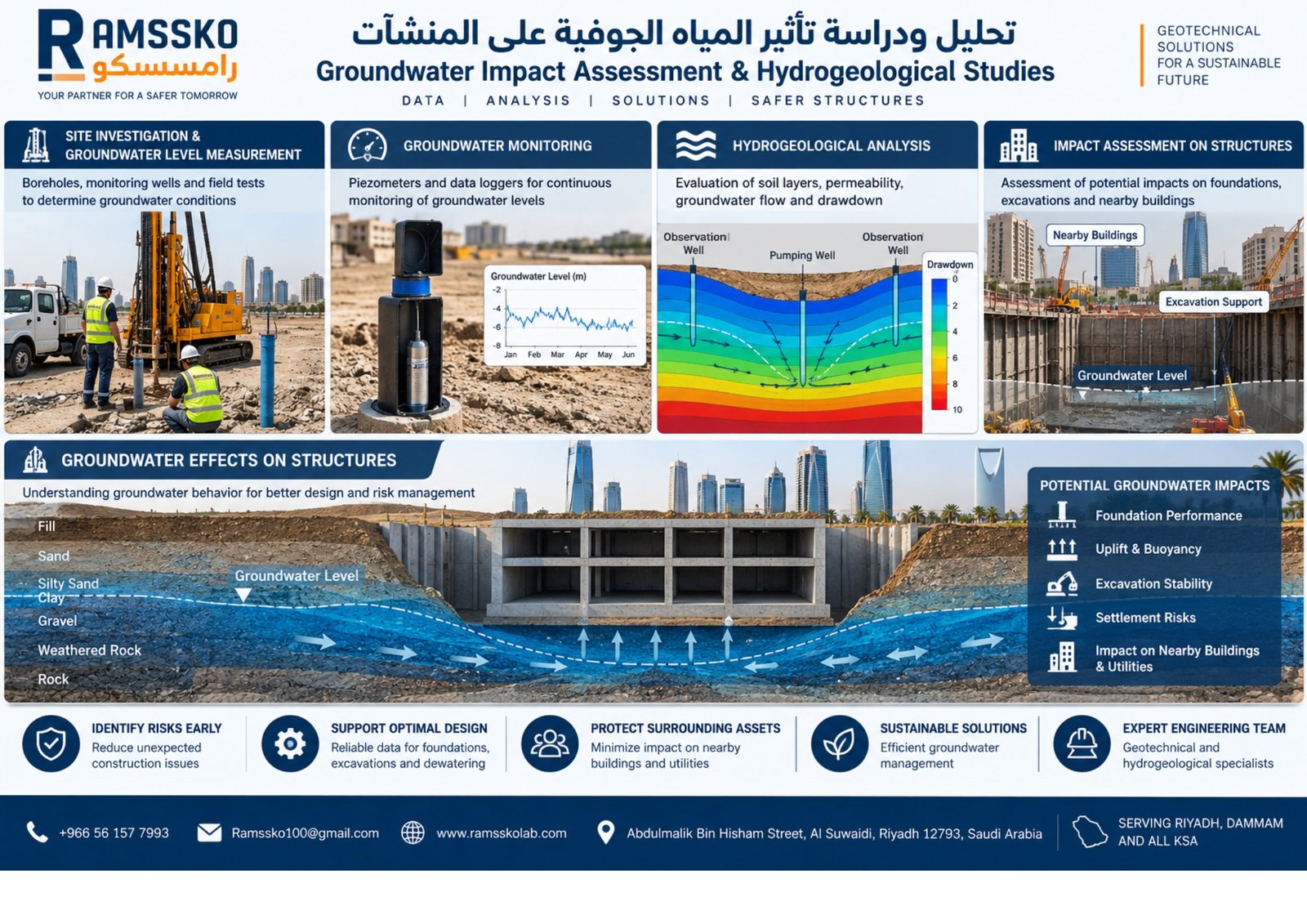
Groundwater Impact Assessment & Hydrogeological Studies are essential geotechnical services for new developments and existing structures, particularly when groundwater is located near foundations, deep excavations, basements, or other underground structures. Groundwater is not simply an excavation issue. It can influence pore-water pressures, soil behavior, excavation stability, foundation performance, waterproofing requirements, drainage systems, and the conditions surrounding nearby structures.
Ramssko Building Materials Laboratory provides specialized groundwater impact assessment and hydrogeological study services for projects across Saudi Arabia, including Riyadh, Dammam, and the Eastern Province. Each study begins with an assessment of the geological, geotechnical, and hydrogeological conditions of the site. Groundwater levels, soil stratification, hydraulic characteristics, foundation levels, and excavation requirements are then evaluated to understand how groundwater may interact with the proposed or existing development.
The results can support engineering decisions related to foundation design, deep excavation, excavation support systems, groundwater dewatering, drainage, waterproofing, and construction monitoring. The objective is to identify groundwater-related risks early and develop engineering recommendations appropriate to the actual site conditions.
What Is a Groundwater Impact Assessment?
A Groundwater Impact Assessment is an engineering study used to identify subsurface groundwater conditions and evaluate their potential effects on a project and its surroundings.
The assessment may include a review of available site information, borehole data, soil investigation reports, recorded groundwater levels, geological conditions, and the proposed foundation or excavation configuration.
The purpose is not simply to identify the depth at which groundwater was encountered. Engineers also need to understand how groundwater may move through different strata, how groundwater levels may change, and how variations in pore-water pressure could affect soil and structural behavior.
For projects involving groundwater lowering, the assessment can also evaluate whether the resulting drawdown could extend beyond the excavation and influence neighboring structures or utilities.
What Are Hydrogeological Studies?
Hydrogeological Studies investigate groundwater and its relationship with geological formations, soil layers, and rock masses.
Depending on the project requirements, a hydrogeological study may evaluate groundwater levels, groundwater flow, aquifer characteristics, hydraulic conductivity, permeability, recharge conditions, and the response of the groundwater system to pumping or construction activities.
For engineering projects, these findings provide important inputs for the design of foundations, deep excavations, dewatering systems, retaining structures, and underground facilities.
A hydrogeological study can therefore connect subsurface groundwater conditions with practical engineering decisions required during both construction and long-term operation.
Why Is Groundwater Assessment Important Before Construction?
Groundwater conditions can significantly influence engineering decisions. Identifying these conditions before construction helps reduce unexpected problems once excavation or foundation works begin.
For example, groundwater may require changes to the excavation method, excavation support system, waterproofing arrangement, drainage design, or dewatering strategy.
An early assessment also allows engineers to consider effects beyond the boundaries of the site. This is particularly important where groundwater lowering may influence adjacent buildings, roads, buried utilities, or other sensitive infrastructure.
Groundwater assessment should therefore be considered as part of the overall geotechnical understanding of the project rather than as an isolated construction-stage issue.
How Does Groundwater Affect Foundations?
The influence of groundwater on foundations depends on several factors, including foundation type, founding depth, soil properties, groundwater level, and structural loading.
Groundwater conditions affect pore-water pressures and effective stresses within the soil. These parameters can be relevant when evaluating bearing capacity, settlement, and overall foundation performance.
For foundations and structures located below groundwater level, engineers may also need to assess hydrostatic pressures and uplift forces.
A suitable groundwater assessment helps establish appropriate design conditions and ensures that foundation calculations reflect the actual or reasonably anticipated subsurface environment.
Groundwater and Building Settlement
When investigating building settlement, groundwater should be evaluated as one of several possible contributing factors. Settlement should not automatically be attributed to groundwater without supporting evidence.
Changes in groundwater conditions can alter pore-water pressures and effective stresses within certain soil formations. In compressible soils, these changes may influence settlement behavior.
A detailed assessment can therefore include a review of groundwater history, soil stratification, foundation configuration, structural loading, and observed movement.
This integrated approach helps determine whether groundwater is contributing to the problem and supports the development of an appropriate engineering solution.
Effects of Rising Groundwater Levels
A rise in groundwater level can increase hydrostatic pressure on underground structures and may affect drainage, waterproofing, excavation conditions, and foundation design.
For structures extending below groundwater level, uplift or buoyancy forces may also need to be evaluated.
This can be particularly important for basements, underground tanks, buried structures, and other facilities exposed to groundwater pressures.
The groundwater level adopted for design should be selected based on appropriate site information and project requirements. Where groundwater levels may vary over time, reliance on a single observation may not adequately represent long-term conditions.
Effects of Groundwater Lowering
Groundwater lowering also requires careful engineering assessment, particularly when it results from construction dewatering.
Reducing groundwater levels changes pore-water pressure within the soil and can consequently alter effective stresses.
In certain compressible soil layers, these changes may contribute to settlement. The potential effect becomes particularly important when sensitive buildings, roads, pipelines, or utilities are located close to the excavation.
The assessment should therefore consider not only whether the excavation can be kept dry, but also the potential influence of groundwater drawdown on the surrounding area.
Groundwater Effects on Deep Excavations
For deep excavation projects, groundwater, soil, and excavation support should be considered as interacting parts of the same geotechnical system.
Groundwater can influence the pressures acting on retaining structures and may affect excavation stability and groundwater inflow.
The groundwater regime should therefore be evaluated alongside excavation stages and the selected retaining system.
Where groundwater control is required, an appropriate dewatering or groundwater management strategy can then be developed based on the expected conditions.
Groundwater Pressure on Underground Structures
Groundwater surrounding an underground structure can generate hydrostatic pressure on walls, slabs, and other structural elements.
These pressures should be considered when designing basements and other below-ground facilities. Uplift forces may also require evaluation where groundwater acts beneath the structure.
The design should consider realistic groundwater scenarios throughout the service life of the structure.
Where permanent drainage is proposed, its performance, maintenance requirements, and possible failure conditions should also be considered as part of the overall engineering approach.
Uplift and Buoyancy Assessment
Underground structures may be exposed to groundwater uplift forces. Where these forces become significant relative to the weight and resistance of the structure, a suitable design solution is required.
Depending on the project, possible solutions may involve changes to the structural system, foundations, anchorage, drainage, or other groundwater-control measures.
The appropriate solution should be selected after determining the design groundwater condition and calculating the resulting forces.
This helps avoid relying on generic solutions that may not match the site’s actual hydrogeological conditions.
Role of the Geotechnical Investigation in Groundwater Studies
The geotechnical investigation report provides important information for understanding subsurface conditions. Boreholes can identify soil and rock strata and record groundwater observations during site investigation.
However, groundwater readings obtained during drilling may not always provide a complete picture for every project. Groundwater levels can vary with time and local conditions.
Sensitive or complex developments may therefore require additional groundwater monitoring or hydrogeological testing.
Combining geotechnical and groundwater information provides a stronger basis for understanding how the site is likely to behave during construction and operation.
Groundwater Level Monitoring
Groundwater Monitoring provides data on how groundwater levels change over time. Monitoring wells or piezometers can be installed where appropriate to the objectives of the investigation.
Repeated measurements can help establish whether groundwater conditions are relatively stable or variable.
Monitoring can also provide valuable baseline information before excavation or dewatering begins and can continue during construction to evaluate actual site response.
For sensitive projects, groundwater monitoring may be integrated with geotechnical instrumentation used to monitor settlement or retaining-wall movements.
Pumping Tests and Hydrogeological Investigations
Some projects may require Pumping Tests or other field investigations to evaluate the response of groundwater to pumping and estimate hydraulic characteristics relevant to the project.
These tests can be particularly valuable when designing a major dewatering system or evaluating the possible influence of pumping over a larger area.
The testing program can include pumping wells and groundwater observation points, with the configuration selected according to the project objectives.
Results can then support the hydrogeological model and provide engineering parameters for groundwater-control design.
Soil Permeability and Groundwater Movement
Soil permeability is an important factor controlling groundwater movement. Water can move through different soil and rock formations at very different rates.
A project site may contain several layers with contrasting hydraulic properties. This can produce groundwater behavior that is more complex than a simple homogeneous soil model.
For this reason, borehole information and field or laboratory test results should be interpreted within an integrated geotechnical and hydrogeological model.
Understanding permeability is particularly important when evaluating groundwater inflow, drawdown, dewatering requirements, and the potential extent of groundwater influence.
Groundwater Effects on Soil Stability
Groundwater conditions are closely related to effective stress in soil mechanics. Changes in pore-water pressure can therefore influence soil strength and stability.
This relationship is important in the assessment of excavations, slopes, embankments, earth dams, retaining systems, and other geotechnical structures.
Groundwater conditions should consequently be incorporated into relevant stability analyses rather than considered separately from soil behavior.
The design groundwater scenario should reflect the conditions that may reasonably occur during construction and operation.
Groundwater and Slope Stability
Groundwater and pore-water pressures can have a significant influence on slope stability.
Changes in saturation conditions or groundwater levels may alter the factor of safety for natural or engineered slopes.
Appropriate slope stability studies should therefore represent groundwater conditions consistent with the design scenarios being evaluated.
Where groundwater is identified as an important risk factor, drainage, pressure-relief measures, or other stabilization solutions can be assessed as part of the engineering design.
Groundwater Effects on Adjacent Buildings and Utilities
The influence of groundwater-related works may extend beyond the boundaries of a construction site.
For projects involving excavation and dewatering, it may be necessary to evaluate the potential zone of influence and identify nearby buildings, roads, pipelines, and utilities that could be sensitive to groundwater changes.
This assessment can help determine whether additional monitoring, changes to the dewatering strategy, or other mitigation measures are required.
The objective is to manage groundwater conditions while minimizing unnecessary effects on the surrounding built environment.
Groundwater Studies and Dewatering System Design
A hydrogeological assessment provides important information for the design of groundwater dewatering systems.
The study helps engineers understand groundwater sources, subsurface layers, hydraulic characteristics, required drawdown, and the expected response of the groundwater system to pumping.
Based on these findings, different dewatering methods can be assessed, including Surface Pumping, Well Point Systems, and Deep Wells.
Groundwater impact assessment and dewatering design are therefore closely related but serve different purposes. The assessment characterizes groundwater behavior and potential impacts, while dewatering design develops the practical system required to control groundwater.
Groundwater and Excavation Support Systems
Groundwater pressures can affect the loads acting on excavation support systems. The groundwater assumptions used in design should therefore be consistent with the expected site conditions.
Retaining systems can also influence groundwater movement, particularly where walls penetrate different soil layers or alter local groundwater flow paths.
Coordination between the hydrogeological assessment, excavation support design, and dewatering strategy is therefore important for deep and complex excavations.
This integrated approach can improve both construction planning and geotechnical risk management.
Groundwater Effects on Concrete and Underground Structures
In addition to geotechnical effects, the environment surrounding buried concrete elements may influence durability requirements.
The chemical characteristics of groundwater and surrounding soils may be relevant when selecting materials and protection systems.
Depending on the project requirements, chemical testing of soil or groundwater may therefore form part of the investigation.
These findings can then be coordinated with structural design, waterproofing, drainage, and durability requirements.
Groundwater Studies for Buildings and Basements
Groundwater assessment is particularly important for buildings containing basements or other underground levels.
As excavation approaches or extends below groundwater level, the design may need to address groundwater inflow, hydrostatic pressures, uplift, waterproofing, drainage, excavation support, and temporary dewatering.
The permanent condition is equally important. Once construction is complete, the structure may continue to interact with groundwater throughout its service life.
The study should therefore consider both temporary construction conditions and long-term groundwater scenarios.
Groundwater Studies for Infrastructure Projects
Hydrogeological Studies are not limited to buildings and towers. They can also support roads, tunnels, utility networks, pumping stations, industrial developments, and other infrastructure projects.
Groundwater may affect excavations, embankments, underground facilities, and construction methods.
At the same time, construction activities can sometimes alter local groundwater flow.
The scope of the assessment should therefore be developed according to the type, scale, depth, and sensitivity of the project.
Groundwater Impact Assessment in Riyadh
Groundwater studies in Riyadh should be based on project-specific information rather than assuming that subsurface conditions are uniform across the city.
Geological formations, soil profiles, and groundwater conditions can vary between sites.
Ramssko provides geotechnical and hydrogeological services for projects in Riyadh, linking soil and groundwater information with foundation, excavation, and structural requirements.
This approach allows potential groundwater issues to be evaluated during the design stage and helps determine whether monitoring, dewatering, drainage, or other groundwater-control measures may be required.
Hydrogeological Studies in Dammam and the Eastern Province
Groundwater Impact Assessment in Dammam and the Eastern Province can be particularly important for projects involving deep excavations, basements, and underground structures.
Groundwater levels and soil conditions should be evaluated specifically for each site. Where dewatering is planned, the possible effects of groundwater lowering on nearby structures and utilities should also be assessed.
Ramssko provides Groundwater Impact Assessment & Hydrogeological Studies for projects in Dammam and the Eastern Province according to the technical requirements and conditions of each site.
Groundwater Impact Assessment Process
The assessment typically begins by collecting available project information, including drawings, excavation and foundation levels, geotechnical investigation reports, and existing groundwater data.
A conceptual geotechnical and hydrogeological model can then be developed. Depending on the complexity and sensitivity of the project, additional monitoring, field investigations, or testing may be recommended.
Groundwater conditions and relevant design scenarios are subsequently analyzed to identify potential impacts on the proposed structure, excavation, foundations, and surrounding developments.
The study can then provide engineering recommendations related to groundwater control, dewatering, foundations, drainage, monitoring, waterproofing, or other relevant measures.
What Information Is Required for a Hydrogeological Study?
The exact requirements depend on the project. However, useful information generally includes borehole and geotechnical investigation data, recorded groundwater levels, site plans, topographic information, foundation levels, excavation depths, proposed structures, and details of nearby buildings and utilities.
Existing groundwater monitoring, pumping-test, or permeability-test data can also be valuable where available.
The quality and extent of the available data influence the reliability of the site model. Where important information is missing, additional investigation may be recommended before completing detailed assessments.
Why Choose Ramssko for Groundwater Impact Assessment?
Groundwater assessment requires an integrated understanding of geotechnical engineering, hydrogeology, foundations, and excavation engineering because groundwater can influence several elements of a project simultaneously.
Ramssko Building Materials Laboratory provides specialized soil investigation, geotechnical studies, and engineering services for projects across Saudi Arabia.
The Groundwater Impact Assessment & Hydrogeological Studies service can include evaluation of groundwater conditions, groundwater levels, soil interaction, foundations, excavations, adjacent structures, and potential groundwater-control requirements.
The scope and engineering recommendations are developed according to the conditions and technical requirements of each project.
Contact Ramssko Building Materials Laboratory
If your project requires a Groundwater Impact Assessment, Hydrogeological Study, groundwater investigation, or assessment of groundwater effects on an existing or proposed structure, you can contact Ramssko to discuss the available site information and determine the appropriate scope of work.
Ramssko provides engineering services for projects across Saudi Arabia, including Riyadh, Dammam, and the Eastern Province, covering soil investigations, geotechnical studies, groundwater assessment, foundations, excavations, and related engineering solutions.
Phone: +9660561577993
Email: Ramssko100@gmail.com
Address: Abdulmalik Bin Hisham Street, Al Suwaidi, Riyadh 12793, Saudi Arabia
Website: Ramssko Building Materials Laboratory
Location: Ramssko Laboratory on Google Maps
Frequently Asked Questions About Groundwater Impact Assessment
What is a Groundwater Impact Assessment?
It is an engineering assessment that investigates groundwater conditions and evaluates their potential effects on soils, foundations, excavations, and existing or proposed structures.
Can groundwater affect building foundations?
Yes. Depending on the soil profile, groundwater level, foundation depth, and type of structure, groundwater conditions can influence geotechnical parameters and foundation behavior.
Can groundwater cause building settlement?
Groundwater should not automatically be considered the cause of settlement. However, changes in groundwater conditions can influence the behavior of certain soils. A detailed assessment is required to identify the actual causes of settlement.
What is the difference between a Hydrogeological Study and a Dewatering Study?
A hydrogeological study investigates groundwater conditions, movement, and potential impacts. Dewatering design uses this information to develop a practical system for lowering or controlling groundwater during construction.
How is groundwater level measured?
Groundwater observations may be obtained during site investigation and through dedicated monitoring wells or piezometers. The appropriate monitoring method depends on the project and required level of detail.
Can groundwater levels change over time?
Yes. Groundwater levels can vary due to natural and human-related factors. For sensitive projects, a single groundwater observation may not adequately represent all relevant design conditions.
Does groundwater affect basements and underground structures?
Yes. Groundwater can generate hydrostatic pressures and uplift forces and can influence waterproofing, drainage, excavation support, and temporary dewatering requirements.
Can construction dewatering affect nearby buildings?
Groundwater lowering can alter subsurface conditions within a zone of influence. For sensitive sites, the potential for settlement or movement of adjacent structures and utilities should therefore be evaluated.
Does Ramssko provide Hydrogeological Studies in Riyadh and Dammam?
Ramssko provides geotechnical and engineering services for projects across Saudi Arabia, including Riyadh, Dammam, and the Eastern Province. Groundwater studies can be developed according to the conditions and requirements of each project.
What information is needed to start a Groundwater Impact Assessment?
Useful information typically includes the geotechnical investigation report, borehole data, groundwater observations, project drawings, excavation and foundation levels, and information about nearby structures and utilities. Additional groundwater monitoring or testing may be recommended after reviewing the available data.
